



Loading profile. Please wait . . .
Eriocaulon koernickianum Van Heurck & Muell.-Arg.
Dwarf Pipewort


Federal Protection: No US federal protection
State Protection: Endangered
Global Rank: G2
State Rank: S1
Element Locations Tracked in Biotics: Yes
SWAP 2015 Species of Greatest Conservation Need (SGCN): Yes
SWAP 2025 Species of Greatest Conservation Need (SGCN): Yes
2025 SGCN Priority Tier: Highest Conservation Concern
Element Occurrences (EOs) in Georgia: 22
Habitat Summary for element in Georgia: Granite outcrops
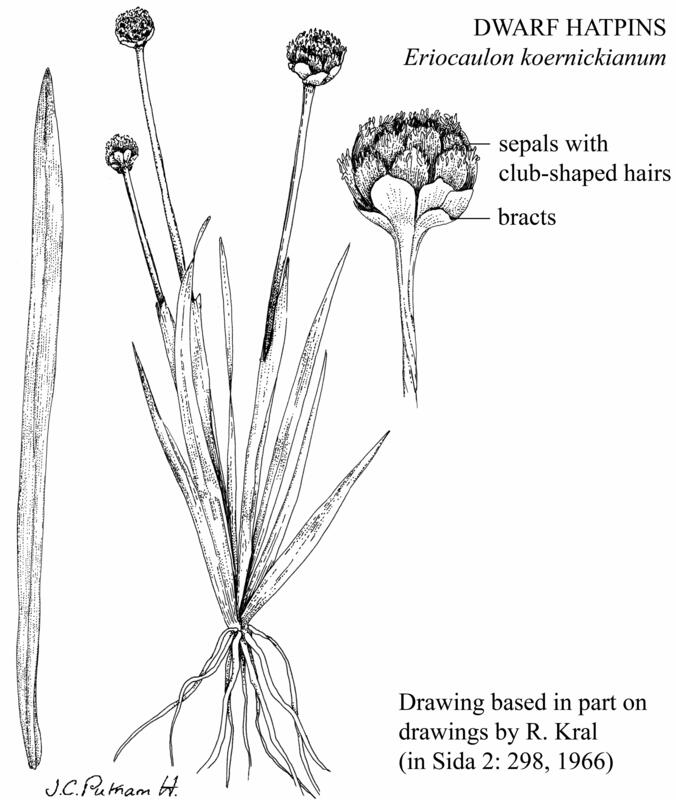
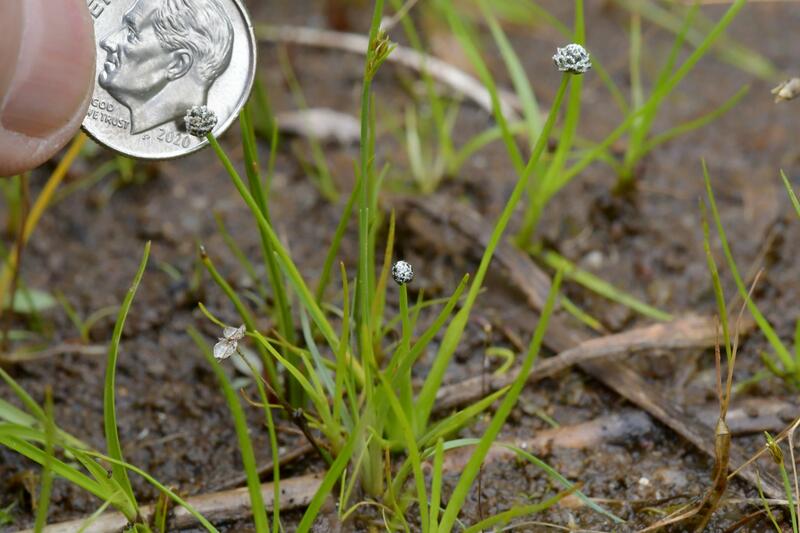
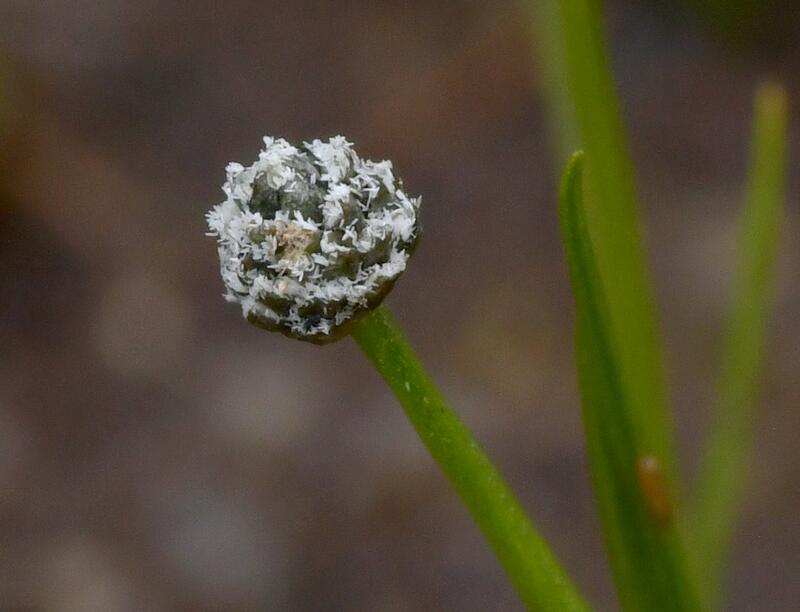
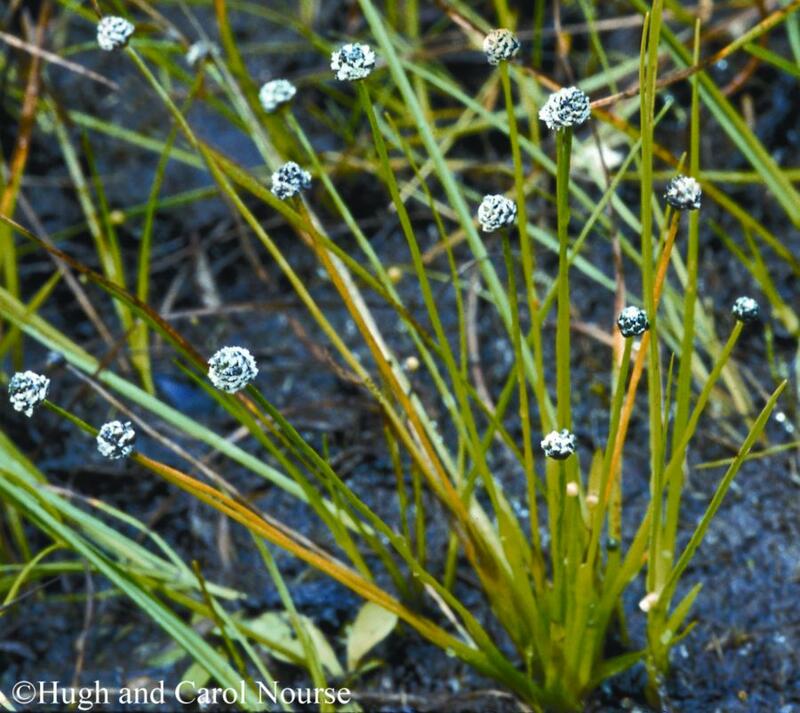
Annual or short-lived perennial herb, forming tufts or rosettes of small, pointed leaves. Leaves are 0.8 - 2 inches (2 - 5 cm) long, very narrow, pale green, with obvious air chambers and clasping, spongy bases. The flower stalk is 2 - 3 inches (5 - 8 cm) tall, twisted, with 3 - 4 vertical ribs; there may be up to 25 flower stalks per plant; a sheath is wrapped around the base of the flower stalk that is about the same length as the leaves. The flower head is 3 - 4 mm across, gray, round or slightly flattened, soft and compressible; flower heads contain both female and male flowers. Individual flowers are tiny and tightly packed into the head; the most conspicuous part of the flower are the two tiny, gray-green sepals bearing white, club-shaped hairs.
When in flower, Dwarf Hatpins is unmistakable – it is the only diminutive member of the pipewort family to occur on Georgia’s Piedmont granite outcrops. The narrow, pointed leaves superficially resemble numerous other granite outcrop plants, especially the quillworts, but the air spaces in the leaves and the spongy, clasping leaf bases are distinctive (quillworts also have hard corms).
Texas Pipewort (Eriocaulon texense, Special Concern) occurs on Altamaha Grit outcrops and in wet pine savannas in the Coastal Plain. Its leaves and flower heads resemble Dwarf Hatpins: the leaves are 0.4 - 2.7 inches (1 - 7 cm) long, and its heads are also small, 0.2 - 0.4 inch (0.5 - 1 cm) broad, white or gray, soft and compressible; it also flowers in the spring. But its flower stalks are taller that Dwarf Hatpines, 2 - 12 inches (5 - 30 cm) tall, and it occurs in the Coastal Plain instead of the Piedmont. For more information, see: http://beta.floranorthamerica.org/Eriocaulon_texense
Southern Bog-buttons (Lachnocaulon beyrichianum) also has grayish flower heads; it occurs only in the Coastal Plain. For more information, see: https://www.georgiabiodiversity.org/portal/profile?group=plants&es_id=20938
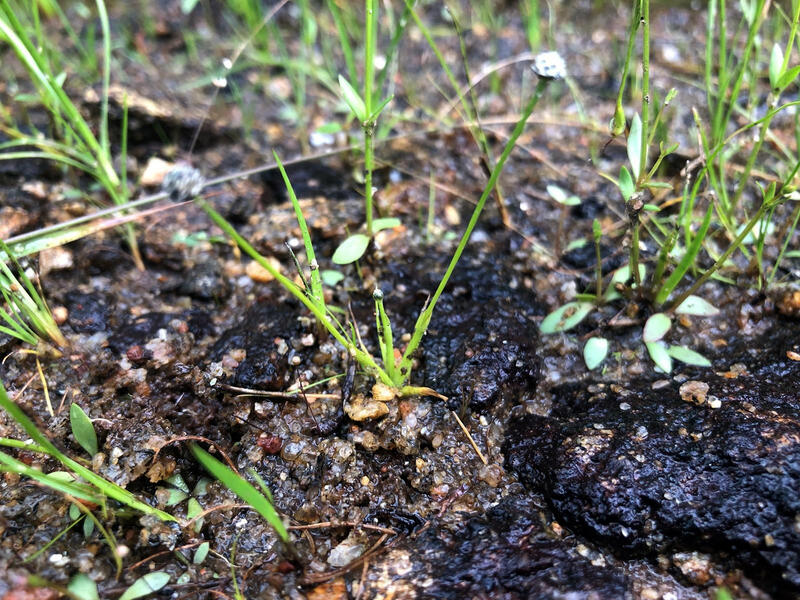
Seepage areas and wet depressions on Piedmont granite flatrocks, often with Horned Bladderwort. In other states, Dwarf Hatpins occurs in wet seeps on sandstone outcrops and in pineland bogs.
Dwarf Hatpins is an annual or short-lived perennial herb that reproduces sexually; it rarely, if ever, reproduces vegetatively. The number of plants in a population fluctuates annually, depending on rainfall. Its flowers depend on outcrossing to effect pollination and, like other members of the genus Eriocaulon, have glands inside the flowers that secrete nectar and attract insect pollinators. Seed set is low and few seeds are preserved in a soil seed bank. Dwarf Hatpins is a poor competitor and depends on frequent natural disturbance, such as fire and/or seepage to reduce competition from other plants.
Surveys are best conducted during flowering (late May–June). Plants may not appear in drought years.
Georgia, Arkansas, Oklahoma, and Texas. Georgia’s plants are separated by more than 600 miles from the nearest populations in Arkansas.
Destruction of habitat by quarrying, trash dumping, and off-road-vehicle use. Development around outcrops. Invasion by exotic pest plant species. Fire suppression.
| Threat 1 | Threat 2 | Threat 3 | |
|---|---|---|---|
| General Threat | Invasive & other problematic species, genes & diseases | Human intrusions & disturbance | Natural system modifications |
| Specific Threat | None | None | None |
Dwarf Hatpins is ranked S1 by the Georgia Department of Natural Resources, indicating that it is critically imperiled in the state. It is listed by the State of Georgia as Endangered and is a candidate for federal listing. About 20 populations have been documented in Georgia, but only three have been confirmed since 2000. Only two populations occur on conservation lands. Populations are variable from year to year, and disappear during dry years.
Protect granite outcrops from quarrying, trash dumping, and off-road vehicle use. Map locations of plans and direct foot traffic away from populations. Eradicate exotic pest plants. Create buffers and limit development around outcrops in order to preserve hydrology. Use fire to limit woody competition. Maintain natural seepage hydrology on and around outcrops.
Chafin, L.G. 2007. Field guide to the rare plants of Georgia. State Botanical Garden of Georgia and University of Georgia Press, Athens.
GADNR. 2020. Element occurrence records for Eriocaulon koernickianum. Georgia Department of Natural Resources, Wildlife Resources Division, Social Circle, Georgia.
Godfrey, R.K. and J.W. Wooten. 1979. Aquatic and wetland plants of southeastern United States, Vol. 1, monocotyledons. University of Georgia Press, Athens.
Kral, R. FNA. 2000. Species account for Eriocaulon koernickianum. Flora of North America, Vol. 22. Oxford University Press, New York. http://www.efloras.org/florataxon.aspx?flora_id=1&taxon_id=222000064
Kral, R. 1966. Eriocaulaceae of continental North America north of Mexico. Sida 2(4):285-332. https://www.jstor.org/stable/41966293
Kral, R. 1983. A report on some rare, threatened, or endangered forest-related vascular plants of the South. Technical Publication R8-TP2. United States Forest Service, Atlanta.
NatureServe. 2019. Eriocaulon koernickianum comprehensive report. NatureServe Explorer. Arlington, Virginia. http://explorer.natureserve.org/servlet/NatureServe?searchName= Eriocaulon koernickianum
Oklahoma Natural Heritage Inventory. 1999. Rare and vulnerable plant species of Oklahoma: Eriocaulon koernickianum, Dwarf Pipewort. Oklahoma Biological Survey, University of Oklahoma, Norman. http://www.oknaturalheritage.ou.edu/erioca2.htm
Watson, L.E., A.B. Kornkven, C.R. Miller, J.R. Allison, N.B. McCarty, and M.M. Unwin. 2002. Morphometric and genetic variation in Eriocaulon koernickianum Van Heurck & Mull.-Argau (Eriocaulaceae): a disjunct plant species of the southeastern United States. Castanea 67(4): 416-426. https://www.jstor.org/stable/4034135
Watson, L.E., G.E. Uno, N.A. McCarty, and A.B. Kornkven. 1994. Conservation biology of a rare plant species, Eriocaulon koernickianum (Eriocaulaceae). American Journal of Botany 81(8): 980-986. https://bsapubs.onlinelibrary.wiley.com/doi/abs/10.1002/j.1537-2197.1994.tb15585.x
Weakley, A.S. 2015. Flora of the southern and mid-Atlantic States. University of North Carolina Herbarium, University of North Carolina, Chapel Hill. http://www.herbarium.unc.edu/flora.htm
Linda G. Chafin
L. Chafin, Mar. 2007: original account
K. Owers, Jan. 2010: added pictures
L. Chafin, Feb. 2020: updated original account.