


Loading profile. Please wait . . .
Desmognathus folkertsi Camp, Tilley, Austin, and Marshall, 2002
Dwarf Black-bellied Salamander


Federal Protection: No US federal protection
State Protection: No Georgia state protection
Global Rank: G2G3
State Rank: S2
Element Locations Tracked in Biotics: Yes
SWAP 2015 Species of Greatest Conservation Need (SGCN): No
SWAP 2025 Species of Greatest Conservation Need (SGCN): No
2025 SGCN Priority Tier:
Element Occurrences (EOs) in Georgia: 25
Habitat Summary for element in Georgia: Rocky streams and seeps in montane hardwood forests
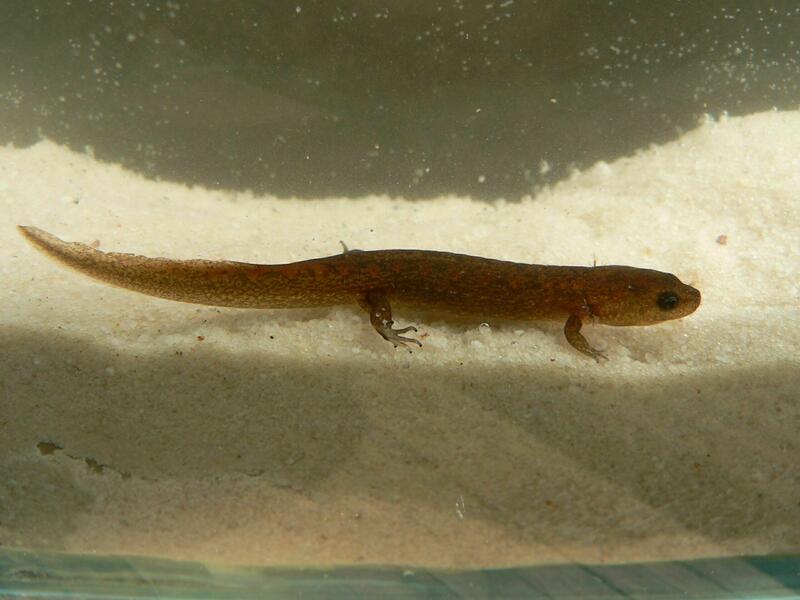
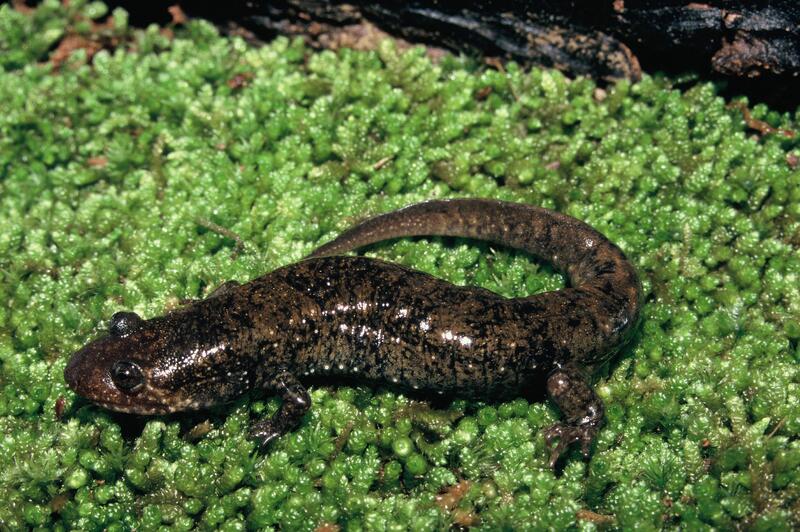
The moderately large dwarf black-bellied salamander (11.5-12 cm or 4.5-4.7 inches total length) has either a vermiculate pattern of brown and black or brown irregular alternating blotches that are similar to the dorsal pattern typical of shovel-nosed salamander species. The head is relatively wide. The belly color is white at metamorphosis, becomes mottled with gray and white in juveniles, and becomes black at a TL of ~5 cm (~2 inches) and an SVL of > 4 cm (1.6 inches). The underside of adult dwarf black-bellied salamanders is black except for the lighter gray posterior third of the tail. Diagnostic for all dusky salamanders (genus Desmognathus), is a pale diagonal line from the eye to the angle of the jaw, and this species has 14 costal grooves (i.e., deep, vertical groove on the side of a salamander’s body indicating the position of a rib). Larvae resemble southern black-bellied salamander larvae (D. amphileucus) (have conspicuous light flecks laterally and white gills), but are 10% smaller (reaching 8.1 cm or ~3.2 inches), are darker (rarely olive in color), and lack the conspicuous reddish line along the top of the tail fin.
The dwarf black-bellied salamander is considered to be a member of the “Nantahala clade” of genetically related black-bellied salamanders including the southern black-bellied salamander (D. amphileucus), the Cherokee black-bellied salamander (D. gvnigeusgwotli), and the southern shovel-nosed salamander (D. aureatus). In Georgia, portions of the ranges of the D. amphileucus and D. aureatus are sympatric (overlapping geographic distribution) with D. folkertsi, thus the identification of phenotypical differences is desirable for species identification and differentiation of these species with similar appearances. All three species possess two rows of lateral white specks which correspond and flank the pores of the lateral line organ along each side of the body and the base of the tail; each row of spots average one per costal space (i.e., the space between costal grooves).
Although the southern black-bellied salamander lacks a discernible pattern on its back and is about 30 percent larger than the dwarf black-bellied salamander at every comparable stage of development (9-21 cm or 3.5-8.25 inches total length), and D. folkertsi have proportionally shorter limbs and digits, and a more rounded tail, individuals of these two species are nearly impossible to differentiate. However, subadults of the southern black-bellied salamander have a reddish dorsal tail stripe and often have an olive-drab body color – neither character is a trait of the dwarf black-bellied salamander. Additionally, the belly color of the southern black-bellied salamander (that is white at metamorphosis and becomes mottled in juveniles) attains a color of solid jet-black without any pattern or secondary coloration at a snout to vent length (SVL) of > 6 cm (2.4 inches). The tail of both of these species is squarish in cross section at the base and becomes laterally compressed with a thin dorsal keel starting immediately posterior to the vent and a narrow ventral keel is limited to the posterior third of the tail.
Characteristically possessing a light-colored pattern of paired, golden, marbled or lichen-shaped blotches with a dark brown to black background color, the southern shovel-nosed salamander is a moderately large, heavy bodied (11.3-14.8 cm or 4.5-5.8 inches total length) dusky salamander. The pale-colored (dark gray or smoky black) belly may or may not have a mottled pattern. The heads of “shovel-nosed” salamanders are more flattened and wedge-shaped than those of other dusky salamanders.
Other sympatric dusky salamander species can be differentiated from the dwarf black-bellied salamander by both allotopic (occupying different microhabitats) habitat affinity and appearance (refer to the Life History section below). Dwarf black-bellied salamander can be distinguished from seal salamanders (D. monticola) by their black bellies and the two rows of distinct spots associated with the lateral line whereas seal salamanders have bellies lacking pigment and lack lateral-line spots. Seal salamanders typically burrow in streambanks, avoiding the stream proper, where the dwarf black-bellied salamander lives. Ocoee salamander complex (including the Chattooga dusky salamander (D. perlapsus)) are terrestrial or streamside forms possessing tails characteristically round in cross-section and a wide array of boldly colored and patterned backs including red, orange, yellow, and brown spots and straight or zigzagged dorsolateral stripes. Seepage salamanders (D. aeneus) are never found in water.
This salamander prefers high-gradient headwater and second order mountain streams with abundant rock cover. Larvae occupy swift current riffles, particularly those with gravel-sand dominated interstitial spaces. Adults and juveniles are most abundant in flat, shallow, rock-strewn edge habitats providing numerous hiding places.
While adults and juveniles feed on a wide variety of aquatic prey, during wet periods they may forage within the leaf litter of the forest floor as far away as 10 m (~30 feet) from the stream’s edge to acquire terrestrial invertebrate prey that make up their primary diet (bees and wasps, butterflies and moths, beetles, centipedes, and spiders). Larvae eat aquatic prey including mayfly, stonefly, and caddisfly larvae and small crayfish.
For all dusky salamanders, the degree of terrestrial or aquatic affinity of a given species is directly related to that species’ relative size (i.e., length and weight) – in general, the larger the species, the more aquatic, whereas, the smaller the species, the more terrestrial. This pattern holds true for all but the shovel-nosed salamanders, for which this pattern is reversed relative to black-bellied salamander species. Despite their relative sizes, the larger, black-bellied salamanders are inhabitants of the edge of streams (thus, being more terrestrial) and smaller, dwarf black-bellied salamanders are slightly more aquatic than the sympatric southern black-bellied salamanders.
At night adult dwarf black-bellied salamanders can occasionally be observed wandering away from refugia, however they usually remain under rocks with just their heads or the anterior parts of their bodies protruding as they wait in ambush for passing prey.
From April to July females lay clutches of 30-40 eggs (usually every other year), attaching them within a single layer to the underside of stones within the riffles of streams and attending to them until hatching occurs in late summer or fall. Metamorphosis occurs two to three years following hatching, and neoteny (retention of larval physical characteristics) is unknown in this species.
Both adults and juveniles can be collected (hand captured with the aid of a dipnet) from beneath cover objects (stones) within the streambed. Though this species is primarily nocturnal, surveys during daylight hours are generally more successful. Adults appear to be most abundant within shallow areas of streams where they take cover under rocks. Larvae of dwarf black-bellied salamanders occupy interstices of riffle areas of streams. Once the placement of a seine or dipnet is secured directly downstream of a given riffle, larger rocks upstream should be quickly lifted by hand, and gravel and smaller rocks vigorously agitated by foot. Larval dwarf black-bellied salamanders that are present will be dislodged from the stream substrate by this method and swept into the seine or dipnet by the current.
Described as a new species in 2002 from tributaries of the Nottely River in the Blue Ridge Mountains of Union County, Georgia – this species is now known to be restricted to fast-flowing, rocky mountain streams and occurs through much of Georgia’s Blue Ridge (Conasauga, Hiawassee, Nottely, Toccoa, Chattahoochee, and Savannah river systems) and adjacent areas in extreme southwestern North Carolina and extreme southeastern South Carolina. Mitochondrial DNA analysis (mtDNA) has revealed that the range of this species contains three genetic segments.
Because dwarf black-bellied salamanders are heavily dependent on flowing streams possessing rocky substrates (containing plentiful interstitial spaces), they are particularly vulnerable to habitat degradation resulting from siltation and impoundment.
Though not yet reported from the wilds of North America, salamander chytrid fungus (Batrachochytrium salamandrivorans) [or Bsal] has caused a 90% reduction in some salamander populations in Europe. While different species and groups of salamanders show differences in susceptibility to the disease and in the severity of resulting chytridiomycosis, this emergent disease for some plethodontid salamanders has been shown to be lethal in laboratory experiments. Although D. folkertsi has not undergone such testing, it is likely resistant to Bsal, as the closely related northern dusky salamander (D. fuscus) has been shown to present resistance to the disease in a laboratory setting.
Largely because of the species’ restricted geographic range, lack of comprehensive survey data, and near Georgia endemism, this salamander is a species of conservation concern in Georgia and documented occurrences are consequently tracked within the Georgia Department of Natural Resources’ (DNR) conservation database. Populations of D. folkertsi found in Georgia, South Carolina, and North Carolina occur largely on federal lands (National Forest), which conveys some level of protection, and the species is thought to be secure.
Adherence to forestry best management practices (BMPs) in maintaining stream management zones (SMZs) during upland forest harvest as well as maintaining vegetated stream buffers or establishing vegetated buffers along streams in agricultural areas where currently lacking, would improve or help maintain suitability of preferred stream habitats for this species. This is particularly true for those lower elevation, lower gradient streams the dwarf black-bellied salamander’s range in Georgia that tend to be within private ownership. Known occurrences (populations) of the dwarf black-bellied salamander in Georgia should be monitored periodically to confirm the species’ continued presence and to determine possible changes in abundance over time at each site. Additionally, a concerted survey effort across the predicted range in Georgia is suggested to determine current species occupancy, abundance, conservation status, and needed management actions for specific populations.
Camp, C. D. 2004. Desmognathus folkertsi Camp, Tilley, Austin, and Marshall, dwarf blackbelly salamander. Catalogue of American Amphibians and Reptiles 782.1-782.3.
Camp, C. D. and J. L. Marshall. 2006. Reproductive life history of Desmognathus folkertsi (dwarf black-bellied salamander). Southeastern Naturalist 5(4): 669-684.
Camp, C., M. Barbour, and J. Wooten. 2014. Morphological differentiation between the larval forms of two cryptic species of dusky salamander (Desmognathus). Amphibia-Reptilia 35(1): 117-122.
Camp, C. D., J. A. Wooten, C. M. Corbet, E. A. Dulka, J. A. Mitchem, and T. J. Krieger. 2013. Ecological interactions between two broadly sympatric, cryptic species of dusky salamander (genus Desmognathus). Copeia 2013(3): 499–506.
Camp, C. D., S. G. Tilley, R. M. Austin, Jr., and J. L. Marshall. 2002. A new species of black-bellied salamander (genus Desmognathus) from the Appalachian Mountains of northern Georgia. Herpetologica 58(4): 471-484.
Pyron, R. A. and D. A. Beamer. 2022. Nomenclatural solutions for diagnosing ‘cryptic’ species using molecular and morphological data facilitate a taxonomic revision of the black-bellied salamanders (Urodela, Desmognathus ‘quadramaculatus’) from the southern Appalachian Mountains. Bionomina 27(1): 1-43.
Wooten, J. A., C. D. Camp, and L. J. Rissler. 2009. Genetic diversity in a narrowly endemic, recently described dusky salamander, Desmognathus folkertsi, from the southern Appalachian Mountains. Conservation Genetics 11: 835-854.
Thomas M. Floyd
T. Floyd, May 2025: original account