


Loading profile. Please wait . . .
Micranthes careyana (A. Gray) Small
Carey Saxifrage


Federal Protection: No US federal protection
State Protection: No Georgia state protection
Global Rank: G3
State Rank: S1
Element Locations Tracked in Biotics: Yes
SWAP 2015 Species of Greatest Conservation Need (SGCN): No
SWAP 2025 Species of Greatest Conservation Need (SGCN): Yes
2025 SGCN Priority Tier: High Conservation Concern
Element Occurrences (EOs) in Georgia: 4
Habitat Summary for element in Georgia: Moist rock ledges
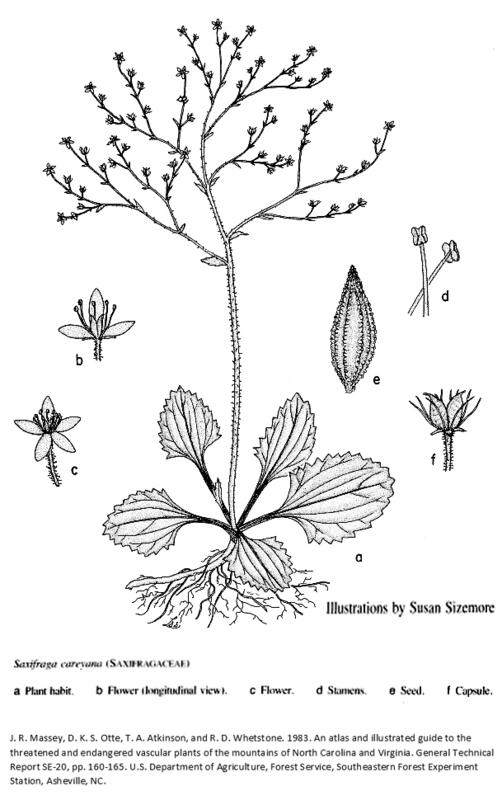
Perennial herb with a single stem, 4 - 12 inches (10 - 30 cm) tall, covered with glandular hairs and rising from a rosette of basal leaves, with 4 - 7 branches at the top. The basal rosette leaves are up to 5.5 inches long and 1.6 inch wide (14 cm long and 4 cm wide), round to oval, upper surface green, lower surface mottled with dark purple, hairy on both surfaces, coarsely toothed, with a very hairy, winged, purple-tinged leaf stalk that is usually longer than the leaf blade. The flower cluster is held at the top of the stem, with many very slender, glandular-hairy branches and flower stalks. Flowers are radially symmetrical, 0.4 – 1 cm wide, with 5 erect or spreading (but not bent downward) green sepals, 5 identical white petals (sometimes with two yellowish-green spots at the base) that are abruptly narrowed (“clawed”) at the base, a 2-parted pistil, and 10 stamens with orange anthers and slender, white filaments. The stamens are as long as or longer than the petals. Fruit is an oval, 2-parted capsule surrounded by persistent sepals and filaments.
Early Saxifrage, Micranthes virginiensis (synonym Saxifraga virginiensis), occurs on granitic outcrops and domes, other rock outcrops, and rocky stream banks in the mountains and Piedmont of Georgia. Its petals are oval or oblong, do not abruptly narrow at the base, and never have yellow-green spots at the base. Its stamens are shorter than the petals.
Michaux’s Saxifrage, Cliff Saxifrage (Hydatica petiolaris, synonym Saxifraga michauxii) occurs on seepy rock outcrops at high elevations. Its flowers are bilaterally symmetrical: the 3 upper petals are abruptly narrowed (“clawed”) at the base and have 2 yellow spots, the 2 lower petals are smaller, wedge-shaped, and not spotted. The leaves taper to a narrow base but do not have stalks.
Micranthes texana (Texas Saxifrage, synonym Saxifraga texana) has been found on one granite outcrop in McDuffie County; it may have been introduced.
Micranthes caroliniana (Carolina Saxifrage, synonym Saxifraga caroliniana) occurs on moist rock outcrops and cliffs in Tennessee, North Carolina, and Virginia. It has not been observed in Georgia as of 2020.
Chrysosplenium americanum (Golden Saxifrage) is also a member of the Saxifrage (Rock-breaker) family. The only known Georgia population occurs in Murray County on rocks above a waterfall.
Damp, moss-covered boulders in boulderfields and mountain seepage slopes; shady, moist rock ledges and cliffs, and along rocky streambanks.
No information on reproduction or ecology of Carey’s Saxifrage has been published, but observations of the common and closely related Early Saxifrage (Micranthes virginiensis) and other species in this genus suggest that Carey’s Saxifrage flowers may be cross-pollinated by syrphid flies and halictid bees, which suck nectar produced by a ring of nectaries at the base of the pistil. Other insect visitors to Micranthes flowers include beetles and flies that feed on the pollen. As with other species in this genus, the stems and leaves of Carey’s Saxifrage are covered with gland-tipped hairs that secrete a sticky substance that deters ants and other crawling insects from reaching the nectar, thus preserving it for the flying insects that are more efficient pollinators.
Surveys are best conducted during flowering, May–June.
Carey’s Saxifrage is a Southern Appalachian endemic found only in northwest Georgia, Tennessee, and North Carolina. It is rare throughout its range.
Logging and other clearing. Climbing and other recreation in the species’ habitat. Changes in hydrology due to altered rainfall patterns related to climate change are likely to negatively effect this species.
| Threat 1 | Threat 2 | Threat 3 | |
|---|---|---|---|
| General Threat | Agriculture & aquaculture | Energy production & mining | Transportation & service corridors |
| Specific Threat | None | None | None |
Carey’s Saxifrage is ranked S1 by the Georgia Department of Natural Resources, indicating that it is critically imperiled in Georgia. Four populations have been documented in Georgia, all on state and federal conservation lands.
Protect habitat from overuse by climbers and hikers. Prevent major disturbances, such as logging or quarrying, in the watersheds where this species occurs. Address climate change.
GADNR. 2019. Element occurrence records for Micranthes careyana. Georgia Department of Natural Resources, Wildlife Resources Division. Social Circle, Georgia.
Brouillet, L. and P.E. Elvander. 2009. Species account for Micranthes careyana. Flora of North America North of Mexico, vol. 8. http://beta.floranorthamerica.org/Micranthes_careyana
Gracie, C. 2012. Early Saxifrage, Micranthes virginiensis. Pages 58-65, in: Spring wildflowers of the northeast: a natural history. Princeton University Press, Princeton, NJ.
Lanning, M.S. and K.G. Mathews. 2019. Taxonomy, distribution, and lectotypification of two rare Southern Appalachian Saxifrages, Micranthes careyana and M. caroliniana. Castanea 84(1): 93-108.
Lord, L.P. 1961. The genus Saxifraga L. in the Southern Appalachians. Ph.D. dissertation, University of Tennessee, Knoxville, Tennessee. https://trace.tennessee.edu/utk_graddiss/4592/
McGuire, A.D. and W.S. Armbruster. 1991. An experimental test for reproductive interactions between two sequentially blooming Saxifraga species (Saxifragaceae). American Journal of Botany 78: 214-219.
Massey, J.R., D.K.S. Otte, T.A. Atkinson, and R.D. Whetstone. 1983. An atlas and illustrated guide to the threatened and endangered vascular plants of the mountains of North Carolina and Virginia. General Technical Report SE-20, pp. 160-165. U.S. Department of Agriculture, Forest Service, Southeastern Forest Experiment Station, Asheville, NC.
NatureServe. 2020. Species account for Micranthes careyana. NatureServe Explorer [web application]. NatureServe, Arlington, Virginia. https://explorer.natureserve.org/Taxon/ELEMENT_GLOBAL.2.137355/Micranthes_careyana
Weakley, A.S. 2015. Flora of the southern and mid-Atlantic States. University of North Carolina Herbarium, University of North Carolina, Chapel Hill. http://www.herbarium.unc.edu/flora.htm
Linda G. Chafin
Linda G. Chafin, 16 April 2020: original account.