


Loading profile. Please wait . . .
Carex baltzellii Chapman ex Dewey
Baltzell's Sedge


Federal Protection: No US federal protection
State Protection: Endangered
Global Rank: G3
State Rank: S1
Element Locations Tracked in Biotics: Yes
SWAP 2015 Species of Greatest Conservation Need (SGCN): Yes
SWAP 2025 Species of Greatest Conservation Need (SGCN): Yes
2025 SGCN Priority Tier: High Conservation Concern
Element Occurrences (EOs) in Georgia: 2
Habitat Summary for element in Georgia: Beech-magnolia slope forests
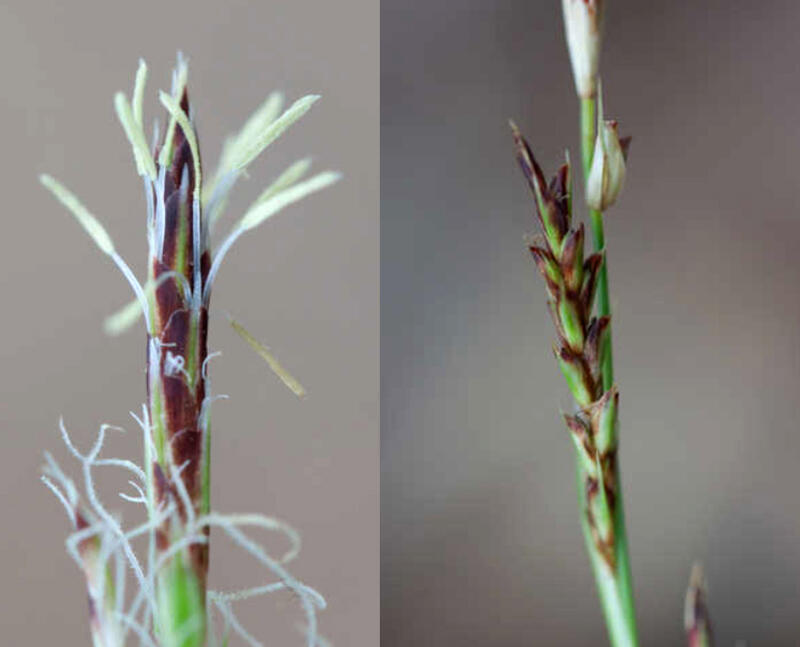
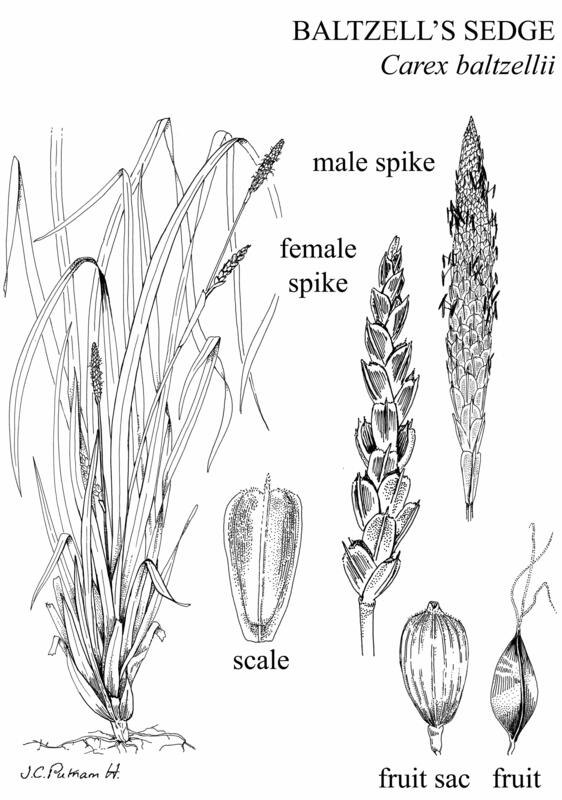
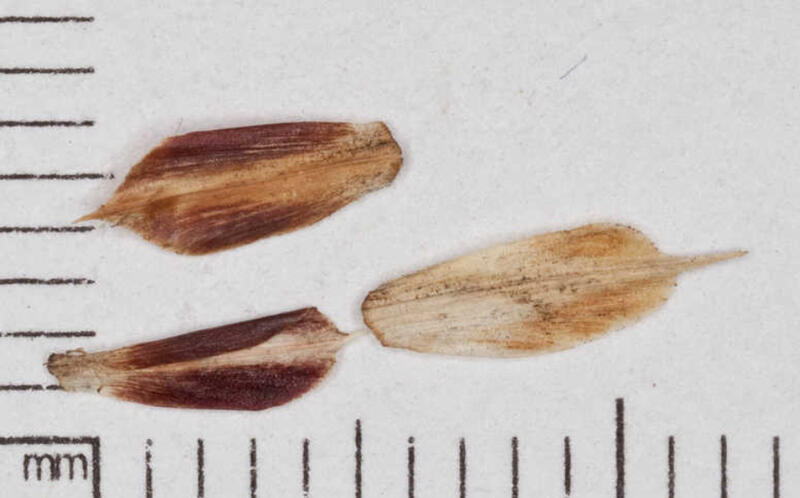
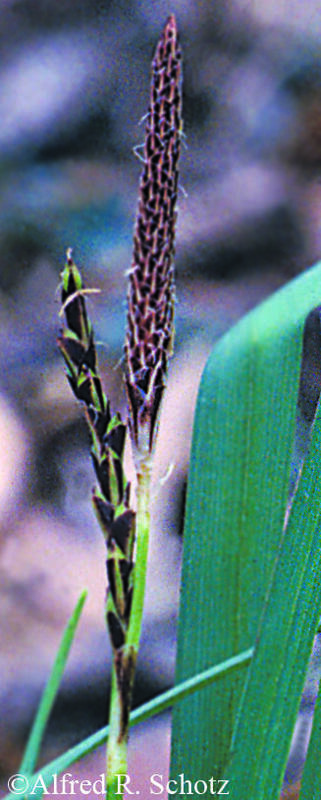
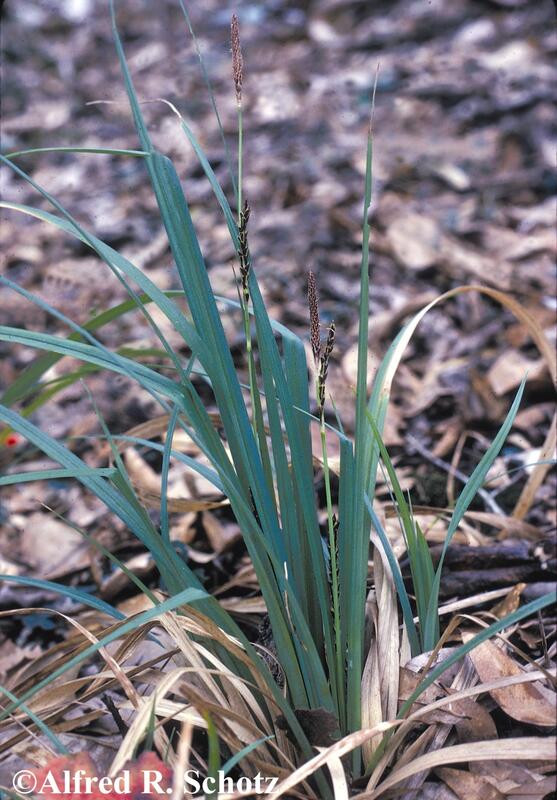
Perennial, evergreen, grass-like herb forming leafy clumps. The leaves are 8 - 30 inches (20 - 80 cm) long and 0.1 - 0.3 inch inch (4 - 8 mm) wide, pale blue-green, roughly hairy on the upper surface, with a tapering tip. Flowering stems are erect, about 1 foot (30 cm) tall, usually shorter than the leaves, each stem bearing both female-flowered and male-flowered spikes. Female-flowered spikes are 0.6 - 1.4 inch (1.5 - 3.5 cm) long, held below the male-flowered spike and sometimes hidden amongst the leaves. Male-flowered spikes are 0.4 - 1.6 inch (1 - 4 cm) long, at the top of the flowering stem. Both female and male spikes are composed of tiny, overlapping, sharp-pointed, dark reddish-purple scales with yellow edges and midveins; each scale encloses an inconspicuous floret that produces a 3-angled fruit. Fruits are about 0.1 inch (3 mm) long, 3-angled, brownish-black, hairy, held on a tiny stalk and enclosed in a papery, ribbed sac (perigynium). Magnification of 10x or higher is needed to examine the spikes and fruits.
Other upland sedges in Georgia with blue-green leaves have pale green, not purple, scales (e.g. Carex flaccospermum) or are found only in wetlands (e.g. Carex glaucescens, C. verrucosa, C. joori).
Forty-five species of Carex are rare in Georgia, see: https://georgiabiodiversity.org/portal/element_lists?group=plant. Detailed information about 11 rare Carex species is provided on this website:
Acid-Loving Sedge (C. acidicola): https://georgiabiodiversity.org/portal/profile?group=plants&es_id=34933
Baltzell's Sedge (C. baltzellii): https://georgiabiodiversity.org/portal/profile?group=plants&es_id=15974
Granite Dome Sedge (C. biltmoreana): https://georgiabiodiversity.org/portal/profile?group=plants&es_id=19146
Lime-fleeing Sedge (C. calcifugens): https://georgiabiodiversity.org/portal/profile?group=plants&es_id=33655
Velvet Sedge (C. dasycarpa): https://georgiabiodiversity.org/portal/profile?group=plants&es_id=15939
Cypress-knee Sedge (C. decomposita): https://georgiabiodiversity.org/portal/profile?group=plants&es_id=21206
Meager Sedge (C. exilis): https://georgiabiodiversity.org/portal/profile?group=plants&es_id=34936
Wretched Sedge (C. misera): https://georgiabiodiversity.org/portal/profile?group=plants&es_id=16740
Radford’s Sedge (C. radfordii): https://georgiabiodiversity.org/portal/profile?group=plants&es_id=15374
Roan Mountain Sedge (C. roanensis): https://georgiabiodiversity.org/portal/profile?group=plants&es_id=21034
Thorne's Sedge (C. thornei): https://georgiabiodiversity.org/portal/profile?group=plants&es_id=34939
Moist, hardwood forests in Coastal Plain ravines, usually mid-slope, under a canopy of Beech, Southern Magnolia, White Oak, and Spruce Pine.
Baltzell’s Sedge is a perennial, evergreen herb. Like most sedges, it is wind-pollinated. Nothing is published about seed dispersal or other aspects of reproduction for this species.
Surveys are best conducted during fruiting (May–June) because fruits are important for identification; however, no other sedge in this upland habitat has blue-green leaves and dark reddish-purple scales on the spike. Baltzell’s Sedge flowers late March–early April.
Coastal Plain of Georgia, Florida, Alabama, and Mississippi.
Logging and clearing, invasion by exotic pest plants, digging by feral hogs, and conversion of habitat to pine plantations and residential and commerical developments.
| Threat 1 | Threat 2 | Threat 3 | |
|---|---|---|---|
| General Threat | Pollution | Climate change & severe weather | None |
| Specific Threat | None | None | None |
Carex baltzellii is ranked S1 by the Georgia Department of Natural Resources, indicating that it is critically imperiled in the state. It is listed as Endangered by the State of Georgia. Only one population – on private land in Early County – is documented. Plants were reported from Thomas County in the 1800s but have not been seen there since.
Protect rich slopes and ravine forests from clearing, erosion, and conversion to pine plantations and development. Eradicate exotic pest plants such as Japanese Honeysuckle. Control feral hog population.
Ball, P.W. 2003. Carex baltzellii species account. Flora of North America, vol. 23, Magnoliophyta: Commelinidae (in part), Cyperaceae (part 1). Oxford University Press, New York. http://www.efloras.org/florataxon.aspx?flora_id=1&taxon_id=242357069
Chafin, L.G. 2007. Field guide to the rare plants of Georgia. State Botanical Garden of Georgia and University of Georgia Press, Athens.
GADNR. 2019. Element occurrence records for Carex baltzellii. Georgia Department of Natural Resources, Wildlife Resources Division, Social Circle, Georgia.
Kral, R. 1983. A report on some rare, threatened, or endangered forest-related vascular plants of the South. Technical Publication R8-TP2. U.S. Forest Service, Atlanta.
NatureServe. 2019. Carex baltzellii comprehensive report. NatureServe Explorer. Arlington, Virginia. http://explorer.natureserve.org/servlet/NatureServe?searchName=Carex%20baltzellii
Patrick, T.S., J.R. Allison, and G.A. Krakow. 1995. Protected plants of Georgia. Georgia Department of Natural Resources, Natural Heritage Program, Social Circle.
Weakley, A.S. 2015. Flora of the southern and mid-Atlantic States. University of North Carolina Herbarium, University of North Carolina, Chapel Hill. http://www.herbarium.unc.edu/flora.htm
Linda G. Chafin
L. Chafin, Oct. 2007: original account.
K. Owers, Jan. 2010: updated status and ranks, added pictures.
L, Chafin, Jan 2020: updated original account.