


Loading profile. Please wait . . .
Schoenoplectiella hallii (A. Gray) Lye
Hall Bulrush


Federal Protection: No US federal protection
State Protection: No Georgia state protection
Global Rank: G3
State Rank: SH
Element Locations Tracked in Biotics: Yes
SWAP 2015 Species of Greatest Conservation Need (SGCN): No
SWAP 2025 Species of Greatest Conservation Need (SGCN): No
2025 SGCN Priority Tier:
Element Occurrences (EOs) in Georgia: 2
Habitat Summary for element in Georgia: Pond shores in peaty sands
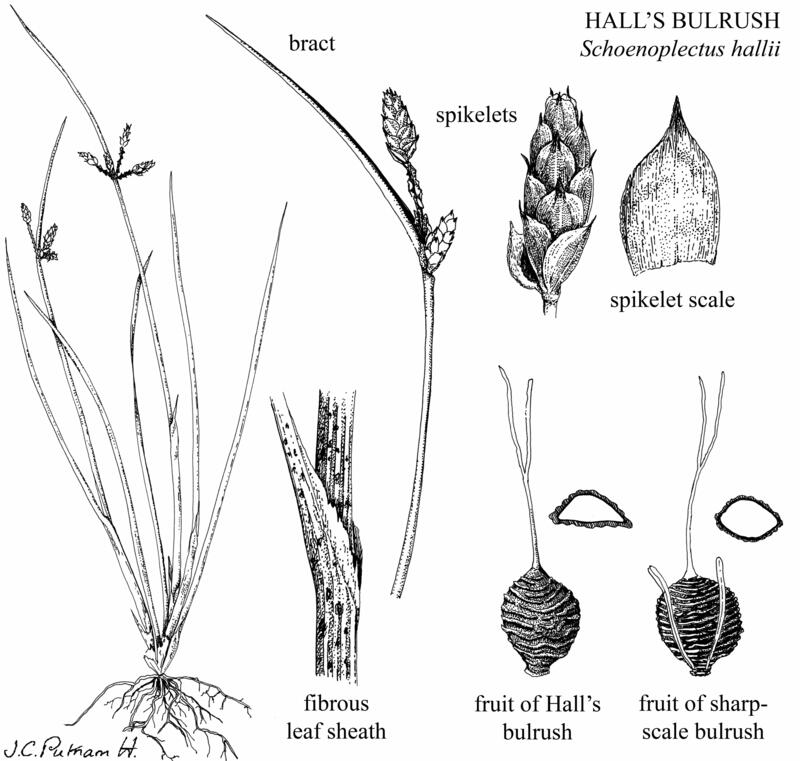
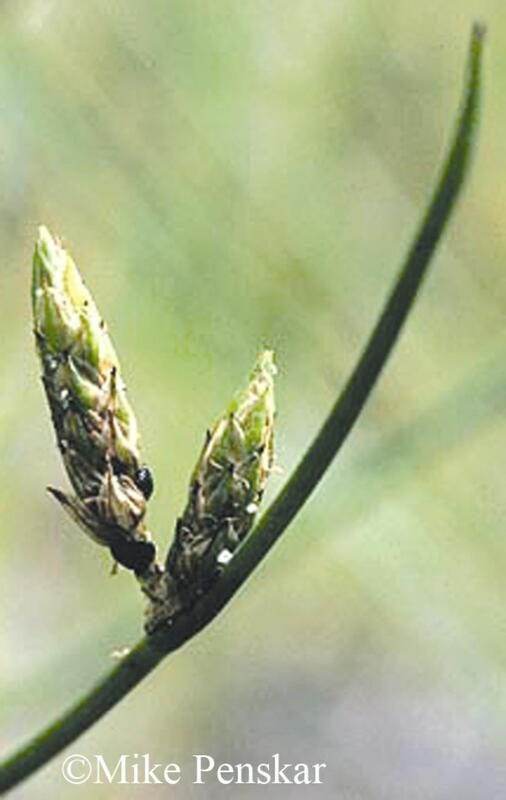
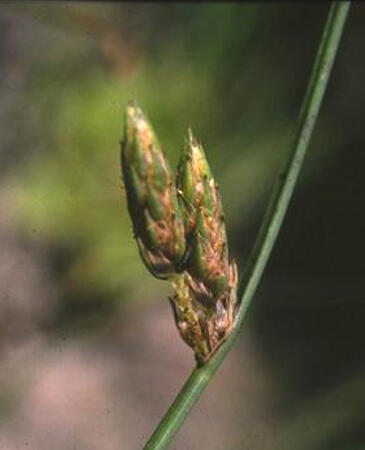
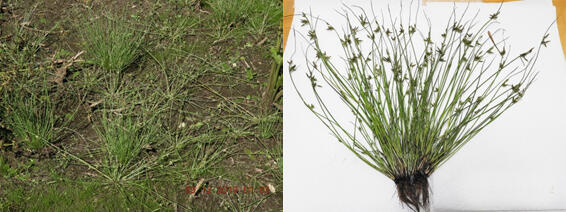
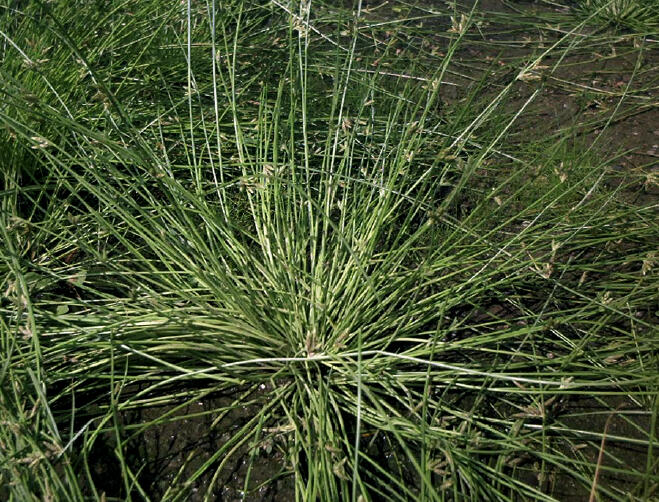
Annual or short-lived perennial herb forming small tufts of grass-like leaves and occasionally producing short, slender rhizomes. The flowering stems are 2 - 32 inches (5 - 80 cm) tall, round in cross-section, soft, often resting on the ground and arching upwards. The leaves are 4 or 5 in number, 3 or 4 at the base of the plant and one on the stem; they are up to 8 inches (20 cm) long, the lower part of the leaf is C-shaped in cross-section, the upper part of the leaf is flat; tan, fibrous sheaths wrap around the bases of stems and leaf blades and disintegrate into fibers. The flower clusters have 1 - 5 oval spikelets; an erect bract extends 1 - 6 inches beyond the spikelets, making it appear that the flower clusters emerge from the side of the stem. Spikelets are less than 0.8 inch (2 cm) long and about 0.1 inch (2 - 3 mm) wide, covered with colorless, green, or pale orange-brown scales that have a pale green midrib. Fruits are 1.7 mm long, black or brown, seed-like, with wavy, horizontal ridges; round or oval in outline, broadly rounded with one flat side in cross-section. Plants may have amphicarpic flowers and fruits hidden among the leaf sheaths at the base of the stem. Magnification of 10x or higher of the fruits is needed to make a positive identification of this species.
Sharp-scale Bulrush (Schoenoplectus erectus ssp. raynallii, synonyms: Scirpus erismaniae, Schoenoplectiella erecta ssp. raynalii) closely resembles Hall’s Bulrush, but its fruits are oval in cross-section (see drawing, lower right). It also occurs on pond shores in southwest Georgia. For more information, see: https://www.georgiabiodiversity.a2hosted.com/portal/profile?group=plants&es_id=34960
Spikerushes (Eleocharis spp.) have a similar growth form, but all have a single, tiny, cone-like spike at the tip of their stems.
Sharp-scale Bulrush (Schoenoplectus erectus ssp. raynallii, synonyms: Scirpus erismaniae, Schoenoplectiella erecta ssp. raynalii) closely resembles Hall’s Bulrush, but its fruits are oval in cross-section (see drawing, lower right). It also occurs on pond shores in southwest Georgia. For more information, see: https://www.georgiabiodiversity.org/portal/profile?group=plants&es_id=34960
Clearwater Bulrush (Schoenoplectus etuberculatus, synonym: Scirpus etuberculatus) occurs in marshes, shallow ponds, peaty swamps, in the Coastal Plain, Fall Line, and lower Piedmont ecoregions, including the Okefenokee Swamp. For more information, see: https://www.georgiabiodiversity.org/portal/profile?group=plants&es_id=16837
Peaty sand around the edges of natural ponds with fluctuating water levels, edges of temporary ponds, low, wet places in fields.
Hall’s Bulrush is an annual herb that reproduces sexually and possibly through apomixis (seed production without fertilization). It grows around the edges of ponds where fluctuating water levels periodically expose bare sand and mud and discourage competing vegetation. It may disappear from a pond for years, then its seeds will germinate when drought or other drawdown expose bare, wet sand or mud around the pond. Research has shown that the seeds mature in the fall but remain dormant until a combination of flooding, light, and ethylene (a plant hormone produced by flooded, organic soils that promotes seed germination) signal that conditions are optimum for seed germination and plant growth. The seeds are dispersed by migrating waterfowl that carry seeds on their feathers or feet.
Schoenoplectiella hallii is also known as Scirpus hallii and Schoenoplectus hallii.
Surveys must be conducted during fruiting (September–October) since mature fruits are needed for identification.
Georgia, Illinois, Indiana, Iowa, Kansas, Kentucky, Massachusetts, Michigan, Missouri, Nebraska, Ohio, Oklahoma, Texas, Wisconsin.
Destruction of habitat by ditching, draining, and filling ponds. Fire suppression and encroachment by woody plants into pond edges. Trampling by cows. Use of ponds by off-road vehicles. Plowing firebreaks in the ecotones between ponds and surrounding uplands. Lowering of water table by excessive withdrawal from the Floridan Aquifer. Low levels of genetic diversity associated with apomixis.
Hall's Bulrush is ranked SH by the Georgia Department of Natural Resources, indicating that its presence in Georgia is historic and that the species has not been seen in many decades. One population was known in Dougherty County, but these plants have not been seen since 1946; another population in Baker County has not been seen since 1966. Both populations were on private lands. Bulrushes are hard to identify so this species may have been overlooked elsewhere in southwest Georgia.
Avoid filling or draining natural ponds. Apply prescribed fire to surrounding uplands every 2 - 3 years during the growing season, allowing fire to burn into pond edges. Avoid placing firebreaks around ponds. Exclude cattle and off-road vehicles from natural ponds. Prevent permanent drying of ponds by regulating withdrawal from the Floridan Aquifer.
Baskin, C.C., J.M. Baskin, E.W. Chester, and M. Smith. 2003. Ethylene as a possible cue for seed germination of Schoenoplectus hallii (Cyperaceae), a rare summer annual of occasionally flooded sites. American Journal of Botany 90(4): 620-627. https://bsapubs.onlinelibrary.wiley.com/doi/abs/10.3732/ajb.90.4.620
Beatty, B.L., W.F. Jennings, and R.C. Rawlinson. 2004. Schoenoplectus hallii (Gray) S.G. Sm. (Hall’s Bulrush): a technical conservation assessment. U.S. Forest Service, Rocky Mountain Region. http://www.fs.fed.us/r2/projects/scp/assessments/schoenoplectushallii.pdf
Chafin, L.G. 2007. Field guide to the rare plants of Georgia. State Botanical Garden of Georgia and University of Georgia Press, Athens.
GADNR. 2020. Element occurrence records for Scirpus [Schoenoplectiella] hallii. Georgia Department of Natural Resources, Wildlife Resources Division, Social Circle, Georgia.
McKenzie, P.M., S.G. Smith, and M. Smith. 2007. Status of Schoenoplectus hallii (Hall's Bulrush) (Cyperaceae) in the United States. Journal of the Botanical Research Institute of Texas 1(1): 457-481. https://www.jstor.org/stable/41971438?seq=1#metadata_info_tab_contents
NatureServe. 2020. Schoenoplectiella hallii species account. NatureServe Explorer. NatureServe, Arlington, Virginia. https://explorer.natureserve.org/Taxon/ELEMENT_GLOBAL.2.140335/Schoenoplectiella_hallii
Penskar, M.R. and P.J. Higman. 2002. Special plant abstract for Schoenoplectus hallii (Hall's bulrush). Michigan Natural Features Inventory, Lansing. https://tinyurl.com/y7zwwlzx
Schuyler, A.E. 1969. Three new species of Scirpus (Cyperaceae) in the southern United States. Academy of Natural Sciences of Philadelphia, Notulae Naturae 423: 1-12. https://ansp.org/research/systematics-evolution/resources/scientific-publications/
Smith, S. Galen. 2003. Schoenoplectus hallii species account. Flora of North America, vol. 23. Oxford University Press, New York. http://beta.floranorthamerica.org/Schoenoplectus_hallii
U.S. Fish and Wildlife Service. 2020. Species status assessment for Hall’s Bulrush (Schoenoplectiella hallii), Version 1.0. U.S. Fish and Wildlife Service, Great Lakes Region, Bloomington, Minnesota.
Weakley, A.S. 2015. Flora of the southern and mid-Atlantic States. University of North Carolina Herbarium, University of North Carolina, Chapel Hill. http://www.herbarium.unc.edu/flora.htm
Linda G. Chafin
L. Chafin, Aug. 2008: original account
K. Owers, Feb. 2010: added pictures
L. Chafin, May 2020: updated original account.