



Loading profile. Please wait . . .
Stachys hyssopifolia var. lythroides (Small) J. Nelson
Tallahassee Hedge-nettle


Federal Protection: No US federal protection
State Protection: No Georgia state protection
Global Rank: G5T1Q
State Rank: S1
Element Locations Tracked in Biotics: Yes
SWAP 2015 Species of Greatest Conservation Need (SGCN): Yes
SWAP 2025 Species of Greatest Conservation Need (SGCN): No
2025 SGCN Priority Tier:
Element Occurrences (EOs) in Georgia: 1
Habitat Summary for element in Georgia: Moist longleaf pine savannas; roadside ditches
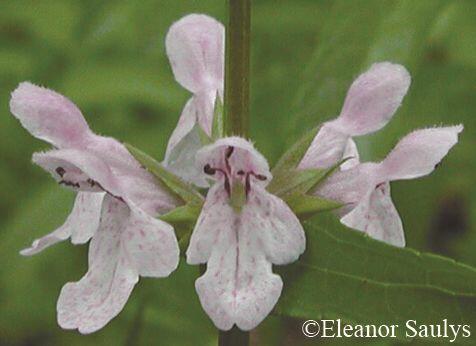
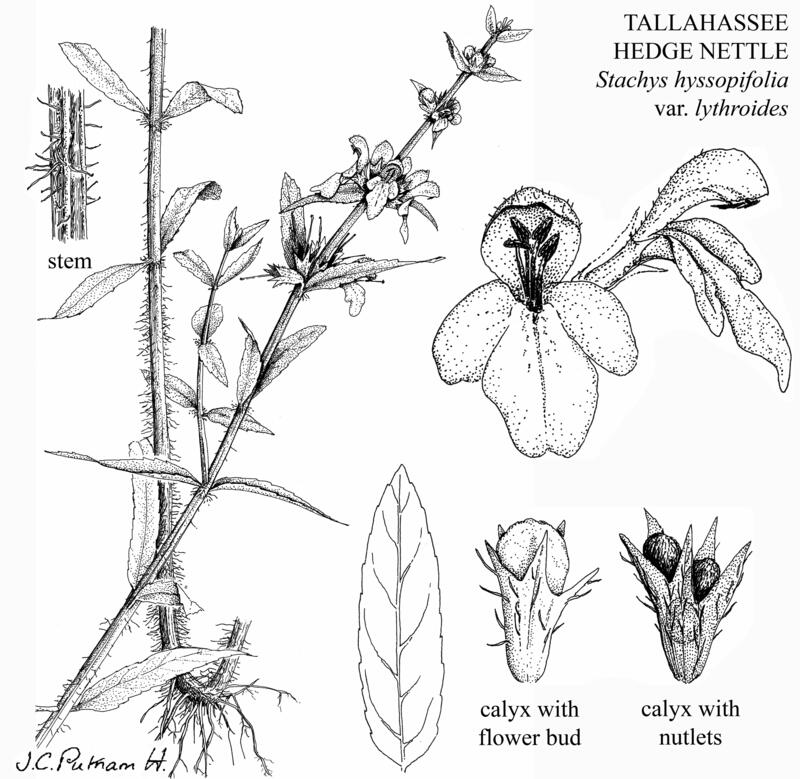
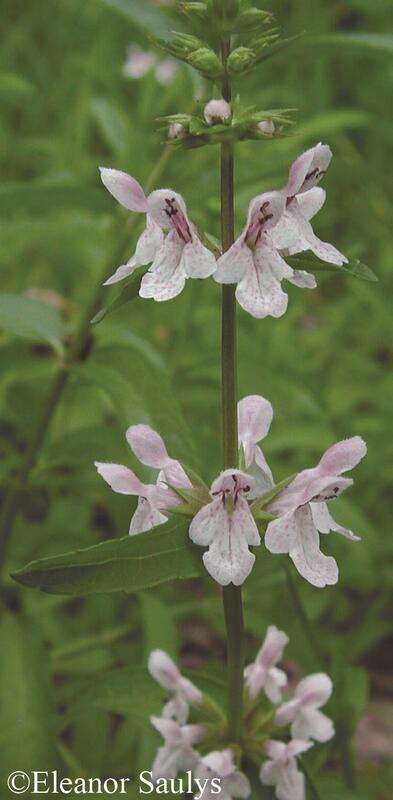
Perennial herb with branching, sprawling, 4-angled stems up to 32 inches (80 cm) tall, with spreading hairs on the angles of the stems and on the leaf nodes. The leaves are up to 1.6 inches (4 cm) long and 0.4 inch (1 cm) wide, opposite with each pair of leaves set at right angles to adjacent pairs; narrowly oblong with blunt tips, hairless, with low teeth along the margins and very short or no leaf stalks. Flower clusters are spaced along the upper stem, each cluster with 2 or more flowers and 2 leafy bracts. The flowers are up to 0.5 inch (1.3 cm) long, pale pink with darker pink spots; they are two-lipped with the upper lip hood-like, the lower lip down-curved and 3-lobed; the calyx has five narrowly triangular, sharply pointed lobes. Fruits consist of 4 tiny nutlets enclosed by the calyx.
Hyssop-leaved Hedge-nettle (Stachys hyssopifolia var. hyssopifolia) has linear or lance-shaped leaves, and its stems are nearly hairless. It occurs in the Coastal Plain in savannas, marshes, sinkholes, and wet roadside ditches.
Florida Hedge-nettle (Stachys floridana) is a weedy plant that occurs in lawns, roadsides, and other disturbed sites; it has long leaf stalks, hairy stems, and 3 - 6 flowers per flower cluster.
Five species of Stachys are rare in Georgia. For more information, see: Nelson, J.B. 1981. Stachys (Labiatae) in southeastern United States. Sida 9: 104-123. https://www.jstor.org/stable/41966598?seq=1#metadata_info_tab_contents
Stachys eplingii (Epling's Hedge-nettle) occurs in moist forests and wet meadows over mafic or calcareous bedrock in north Georgia.
Stachys hispida (Hispid Hedge-nettle) occurs in wet meadows, moist forests, swampy woods, seeps, and boulderfields in north Georgia.
Stachys hyssopifolia var. lythroides (Tallahassee Hedge-nettle) occurs in wet borders of ponds and sinkholes, depressions and moist slopes in Longleaf Pine forests, and clearings in bottomland forests in southwest Georgia.
Stachys latidens (Broad-toothed Hedge-nettle) occurs in cove hardwoods and moist forests in Georgia's western Blue Ridge and upper Piedmont ecoregions.
Stachys nuttallii (Nuttall's Hedge-nettle) occurs in moist hardwood forests over basic soils; alluvial bottomlands in Georgia's western Blue Ridge and Ridge & Valley ecoregions.
Wet borders of ponds and sinkholes, depressions and moist slopes in Longleaf Pine forests, and clearings in bottomland forests.
Tallahassee Hedge-nettle is a perennial herb that reproduces sexually. Its flowers are visited by a variety of insects – including bees, butterflies, skippers, and moths – seeking nectar and pollen but they are probably pollinated only by long-tongued bees which probe for nectar at the base of the flower tube. The shape of the flower and arrangement of the stamens bring the pollen-bearing anthers in contact with the back of the bee, where pollen is deposited out of reach of the bee’s legs. The pollen is then brushed off on another flower’s stigma rather than being carried to the bee’s nest. Flowers are followed by fruits consisting of 4 tiny nutlets which are dispersed by gravity and small animals.
Surveys are best conducted during flowering (late June–September).
Southwest Georgia and adjacent north Florida.
Conversion of habitat to pine plantations, pastures, and developments. Alteration of natural hydrology by ditching, draining, and filling wetlands. Lowering of the water table by excessive withdrawal from the Floridan Aquifer. Fire suppression and encroachment by woody plants. Firebreak construction in ecotones between wetlands and uplands. Rooting and wallowing by feral hogs.
Stachys hyssopifolia var. lythroides is ranked S1 by the Georgia Department of Natural Resources, indicating that the species is critically imperiled in Georgia. Only one population has been documented in Georgia; it occurs on private land.
Apply prescribed fire to Longleaf Pine stands every 2 - 3 years, primarily in the growing season. Avoid placing firebreaks through or around wetlands; allow fires to burn through wet areas. Protect sites from mechanical clearing and conversion to pine plantations and developments. Eradicate feral hogs.
Chafin, L.G. 2007. Field guide to the rare plants of Georgia. State Botanical Garden of Georgia and University of Georgia Press, Athens.
Claßen-Bockhoff, R. 2007. Floral construction and pollination biology in the Lamiaceae. Annals of Botany 100(2): 359-360. https://academic.oup.com/aob/article/100/2/359/104725
GADNR. 2020. Element occurrence records for Stachys hyssopifolia var. lythroides. Georgia Department of Natural Resources, Wildlife Resources Division, Social Circle, Georgia.
Godfrey, R.K. and J.W. Wooten. 1981. Aquatic and wetland plants of southeastern United States, Vol. 2, dicotyledons. University of Georgia Press, Athens.
Nelson, J.B. 1981. Stachys (Labiatae) in southeastern United States. Sida 9: 104-123. https://www.jstor.org/stable/41966598?seq=1#metadata_info_tab_contents
Weakley, A.S. 2015. Flora of the southern and mid-Atlantic States. University of North Carolina Herbarium, University of North Carolina, Chapel Hill. http://www.herbarium.unc.edu/flora.htm
Wunderlin, R.P and B.F. Hansen. 2003. Guide to the vascular plants of Florida, 2nd edition. University Press of Florida, Gainesville.
Linda G. Chafin
L. Chafin, Sept. 2008: original account.
K. Owers, Feb. 2010: added pictures.
L. Chafin, May 2020: updated original account.