


Loading profile. Please wait . . .
Myriophyllum laxum Shuttlw. ex Chapman
Loose Water-milfoil


Federal Protection: No US federal protection
State Protection: Rare
Global Rank: G3
State Rank: S2S3
Element Locations Tracked in Biotics: Yes
SWAP 2015 Species of Greatest Conservation Need (SGCN): No
SWAP 2025 Species of Greatest Conservation Need (SGCN): Yes
2025 SGCN Priority Tier: High Conservation Concern
Element Occurrences (EOs) in Georgia: 27
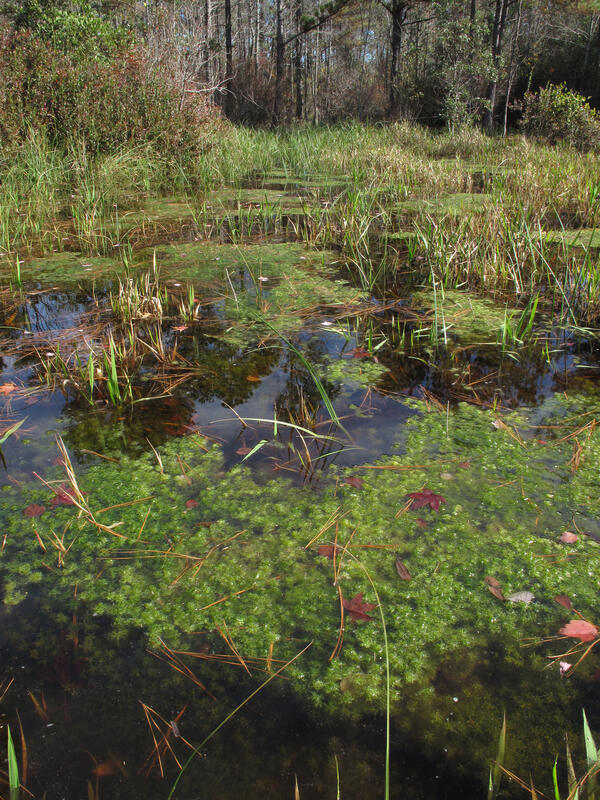
Habitat Summary for element in Georgia: Bluehole spring runs; shallow, sandy, swift-flowing creeks; clear, cool ponds
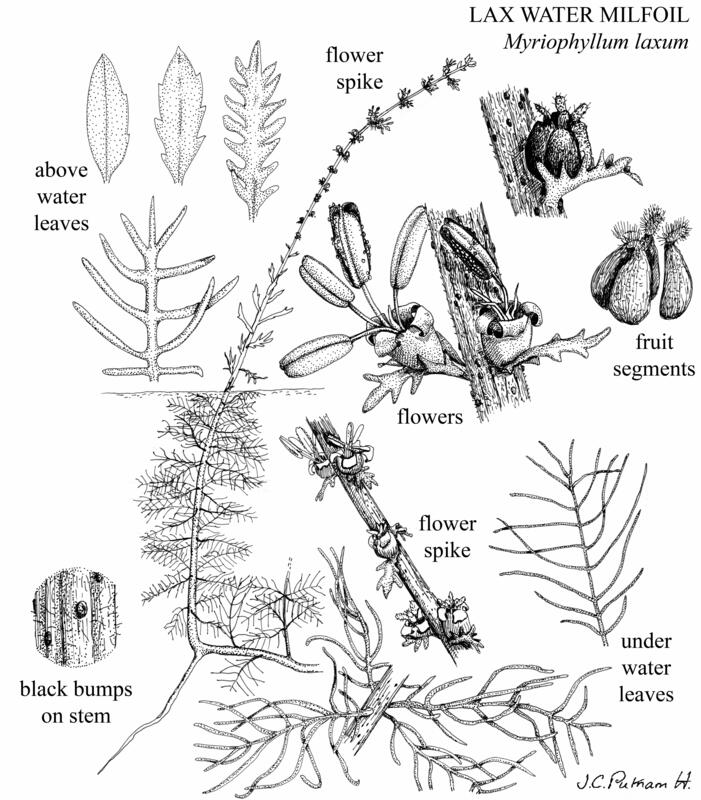
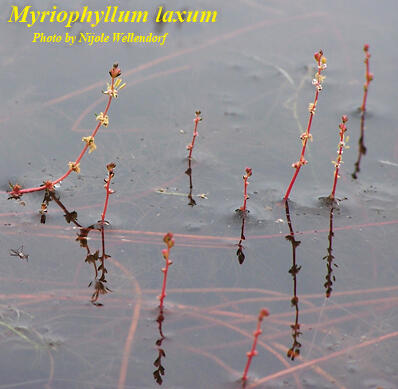
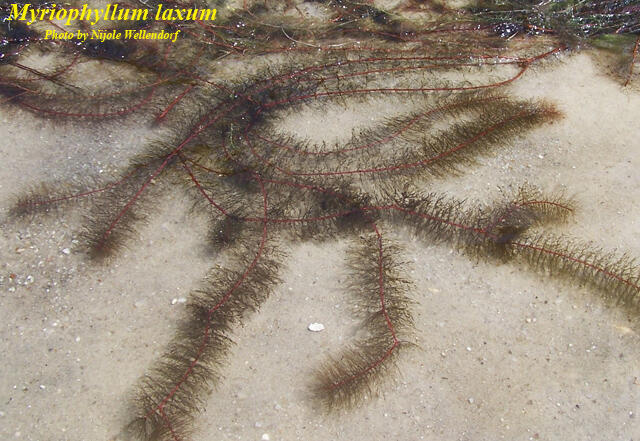
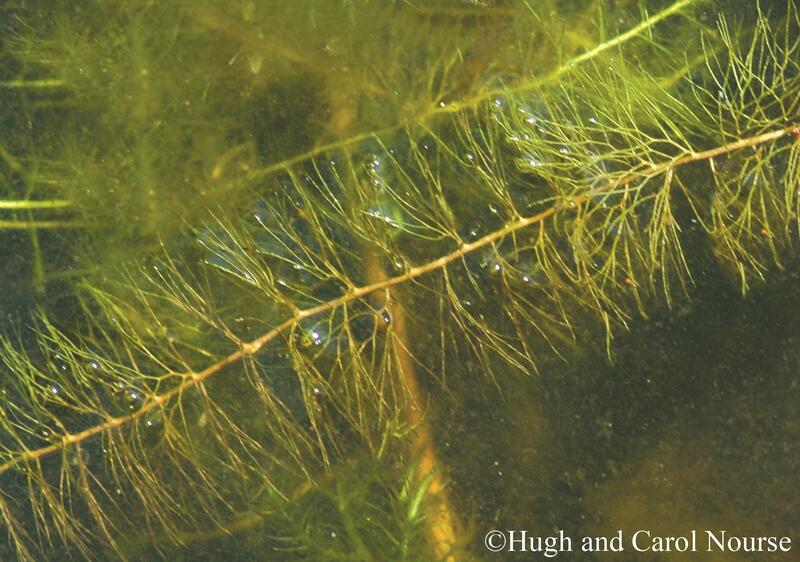
Perennial, aquatic herb with slender underwater stems up to 3 feet (1 meter) long, branched, rooting on the bottom, reddish with black bumps (hydathodes); leaf segments spread when underwater in bottlebrush fashion along the length of the stems. Underwater, submersed leaves are 1 - 2 inches long (3 - 5 cm) and about 0.6 inch (1.5 cm) wide, grayish-green or reddish-green, alternate or sometimes so closely spaced that they appear to be in whorls of 3 - 5 leaves. Each leaf is subdivided into 7 - 21 thread-like, flexible segments that hang limply in the water and readily intertwine; the number of leaves per whorl and the number of segments per leaf may vary, depending on water conditions. Abovewater, emergent stems are 1 - 6 inches (2.5 - 15 cm) long, held more or less erect above the water, with scattered, tiny, bract-like leaves. Flower spikes are held erect at the tips of the emergent stems (see photo below); female flowers are usually on the lower portion of the spike, male flowers on the upper. The flowers are tiny and reddish, each with 4 petals. Fruits are tiny, oval or round, and red. Because the bracts, flowers, and fruits are so small, the abovewater stem appears bare.
The submerged leaves of other native Water Milfoils are more feather-like, with the leaf segments opposite and stiff, not limp and intertwined. Myriophyllum pinnatum leaves are always and only alternate. Myriophyllum heterophyllum has opposite lower leaves and alternate upper leaves.
Eurasian Water Milfoil (MMyriophyllum spicatum) is an invasive, exotic species. Its leaves are whorled with 4 leaves per whorl; the leaves spread stiffly from the stem and the leaf segments are not limp and intertwined (see photo below). There are 14 - 20 thread-like leaflets per leaf. Its emergent stems have red tips but the underwater stems are green, brown, or pinkish white. Its flowers, borne on erect emergent stems, are yellow.
Parrot Feather (Myriophyllum aquaticum, synonym: M. brasiliense) is an invasive, exotic species. Its underwater stems and leaves are a waxy, pale blue-green color but the stem tips may be reddish. Both its underwater and emergent leaves are stiff and feather-like, held in whorls of 4 - 6 leaves with stiffly spreading leaf segments that are not lax and intertwined like Lax Water-milfoil's. Parrot Feather has conspicuous emergent stems up to a foot tall with obvious feather-like leaves about the same size and shape as the submerged leaves. Parrot Feather does not produce flowers or fruits in North America and reproduces by stem fragments.
None in Georgia.
Fall Line and Coastal Plain sandhill ponds, spring runs, limesink or spring-fed ponds, and clear, sand-bottomed creeks.
Little is known about the biology of Lax Water-milfoil, but it may share life history traits with other Myriophyllum species. Milfoils typically reproduce by fragmentation; fragments of stem produce roots at the leaf nodes and develop into new plants. Milfoils also flower and set seed, but this probably accounts for only a small part of their reproduction. Emergent stems bear flowers that are wind-pollinated; submerged flowers probably self-pollinate. Abovewater flowers produce fruits that dry out and split into four segments that are shed into the water.
Surveys can be conducted throughout the year.
Coastal Plain of Georgia, Florida, Alabama, Mississippi, South Carolina, North Carolina, and Virginia.
Pollution, sedimentation, draining, impoundment, and other degradation of streams, ponds, and their shorelines. Competition from exotic, invasive water plants. Drawdown of the water table by irrigation wells.
| Threat 1 | Threat 2 | Threat 3 | |
|---|---|---|---|
| General Threat | Climate change & severe weather | Residential & commercial development | Agriculture & aquaculture |
| Specific Threat | None | None | None |
Myriophyllum laxum is ranked S2S3 by the Georgia Department of Natural Resources, indicating that it is imperiled or vulnerable in Georgia. It is listed as Rare by the State of Georgia. About 25 populations have been documented in Georgia, most on private land; several sites occur on Fort Benning.
Protect natural hydrology and water levels in ponds and streams. Prevent pollution runoff and sedimentation into ponds and streams. Prevent trampling by cattle around pond edges. Maintain historic water table levels. Limit motorized boat use in ponds. Eradicate invasive Water Milfoil species.
Aiken, S.G. 1981. Conspectus of Myriophyllum (Haloragaceae) in North America. Brittonia 33(1): 57-69. https://link.springer.com/article/10.2307/2806578
Burks, K.C. 2015. Haloragaceae. In, R. P. Wunderlin and B. F. Hansen. Flora of Florida, Vol. 2, Dicotyledons, Cabombaceae through Geraniaceae. University of Florida Press, Gainesville.
Chafin, L.G. 2007. Field guide to the rare plants of Georgia. State Botanical Garden of Georgia and University of Georgia Press, Athens.
Chiocchio, P. 2013. How to identify Loose Water Milfoil, Myriophyllum laxum. Center for Aquatic and Invasive Plants, UF/IFAS, University of Florida, Gainesville. https://www.youtube.com/watch?v=66Q0CZzza1w
GADNR. 2020. Element occurrence records for Myriophyllum laxum. Georgia Department of Natural Resources, Wildlife Resources Division, Social Circle, Georgia.
Godfrey, R.K. and J.W. Wooten. 1981. Aquatic and wetland plants of southeastern United States, Vol. 2, dicotyledons. University of Georgia Press, Athens.
Moody, M.L. and D.H. Kes. 2010. Systematics of the aquatic angiosperm genus Myriophyllum (Haloragaceae). Systematic Botany 35(1): 121-139. https://www.ingentaconnect.com/content/aspt/sb/2010/00000035/00000001/art00014#
NatureServe. 2019. Myriophyllum laxum comprehensive report. NatureServe Explorer. Arlington, Virginia. http://explorer.natureserve.org/servlet/NatureServe?searchName=Myriophyllum+laxum
Patrick, T.S., J.R. Allison, and G.A. Krakow. 1995. Protected plants of Georgia. Georgia Department of Natural Resources, Wildlife Resources Division, Social Circle.
Sorrie, B.A. 1993. Myriophyllum laxum element stewardship abstract. The Nature Conservancy. Arlington, Virginia.
Weakley, A.S. 2015. Flora of the southern and mid-Atlantic States. University of North Carolina Herbarium, University of North Carolina, Chapel Hill. http://www.herbarium.unc.edu/flora.htm
Linda G. Chafin
L. Chafin, Jun 2008: original account
K. Owers, Feb 2010: added pictures
L. Chafin, Mar 2020: updated original account